Over the weekend, I decoupaged our $20 IKEA coffee table with pages from Alice in Wonderland and Through the Looking-Glass. Of course, I didn't tear up my own beloved book that I've had since I was little. I ordered a used copy from AbeBooks. Unfortunately, I wasn't quite finished when I ran out of pages, so I guess I need to order one more.
Tuesday, February 16, 2010
Alice in Wonderland in three dimensions.
Friday, January 29, 2010
Pulling a Ginsberg?
Shortly after moving to San Francisco, I went to the Beat Museum, and then to City Lights, where I bought The Dharma Bums, Naked Lunch, and Howl and Other Poems. I liked The Dharma Bums, but I didn't find it particularly earthshaking. I only got through the first third of Naked Lunch before giving up in disgust. But "Howl" resonated pretty strongly with me.
So when I heard that there was going to be a movie about "Howl," I was excited. And when I discovered that there would be a special screening at the Sundance Kabuki Cinema here in San Francisco, followed by a Q&A with the filmmakers, I bought tickets immediately.
Ed and I saw the movie last night, and we both enjoyed it very much. It is not a traditional feature film nor a documentary, and some might be underwhelmed by the unusual juxtaposition of courtroom drama, direct narration pulled from interviews, a reading of the poem itself, and animated sequences. But it worked for me. I wished there had been more hand-drawn animation and less computer animation, but I understand that that would have been prohibitively expensive and time-consuming. It would have been nice if the computer animation could have at least been made to resemble traditional animation more, because I found certain parts of the animated sequences too cold and slick. But that is my only complaint. James Franco is obviously much too attractive to portray Allen Ginsberg convincingly, but he managed to be the perfect movie star version of Ginsberg. And while I'm on the subject, I'll say that I find Jon Hamm far more attractive when he's portraying a lawyer defending artistic freedom than a womanizing advertising executive. Anyway, the movie is good, I liked it and recommend it.
But also, I'd like to share some facts about Allen Ginsberg's life. He graduated from Columbia with a BA in literature, and then lived in Manhattan for a little while before getting arrested as an accessory to crimes that his friends had committed. Instead of jail, he was sent to a psychiatric institute, and when he got out, he moved back into his father's house in New Jersey for a while. Then he moved to San Francisco. He had a nice apartment in Nob Hill and a job doing market research. He was gratified to find that he could handle a nine to five office job, but he felt stifled and creatively blocked. He was miserable and began seeing a therapist, who asked him what he wanted to do. He told his therapist that he wanted to quit his job, get rid of his nice apartment in Nob Hill, and just move into a small apartment with his boyfriend and write and read and fuck and smoke pot and just do whatever he wanted. So his therapist said, "Why don't you do it, then?" So that's what Ginsberg did, he quit his job and moved into a one room apartment with his boyfriend, and that's when he wrote "Howl."
Now, if you'll indulge me, (and if you're not willing to indulge me, maybe you shouldn't read my indulgent blog where I write about myself all the time) I'd like to share some facts about my life. I graduated from Middlebury with a BA in English, and then lived in Manhattan for a few months. (I lived at 208 East 7th Street. Later in his life, Allen Ginsberg lived at 206 East 7th Street.) But I couldn't find a job and I was very lonely, so I moved back into my parents' house in New Jersey for a while. Then I moved to San Francisco, to be with Ed. We lived near Alamo Square at first, and then we moved into a nice apartment in the Marina. I did an account management internship at an advertising agency, and then I worked as a content producer for a website, reviewing various Internet services. I was gratified to find that I could handle a nine to five office job, but I felt stifled and creatively blocked and lately, I have been kind of miserable. So Ed and I moved out of the Marina and into a studio apartment, and I quit my job.
Today was my last day. Now I am going to take some time off to read and write and just do whatever I want.
Friday, September 25, 2009
Books!!!
All I want to do is read. I want to quit my job so I can stay home and read all day. I wish that, as a (free) alternative to grad school, I could just move to some kind of hybrid of a library and a monastery. I'd take a vow of silence and dedicate myself to nothing but reading for one or two years. Lately, I am so overwhelmed with the desire to read everything all at once, I am finding it impossible to focus on one thing at a time.
I started reading a series of lectures on character archetypes. (Kindly provided to me by Scott, of Go Into The Story.) But thinking about character archetypes reminded me that I had been meaning to read The Portable Jung, which had been sitting on my bookshelf for a couple of months at that point. So I decided to read The Portable Jung before I finished reading Scott's lectures. But it's taking me forever because I keep getting lost in my own thoughts while I'm trying to read. So I decided to take a break from that and read The Journeybook instead. Since The Journeybook is a collection of fairly short essays and interviews, I managed to get through it without getting sidetracked. And then, before I could get back into The Portable Jung, I started reading "The Holy Grail of the Unconscious," from this past Sunday's New York Times Magazine. But for several days I was unable to get past the first couple of pages, because I kept getting the sense that I shouldn't read it until I was able to really give it my full attention. Last night I finally got a chance to finish reading the article and now, of course, I am frantic to read the Red Book. But it won't be available until December 4th and I probably won't actually get my hands on it until Christmas, so in the meantime I have renewed motivation to finish The Portable Jung.
Anyway, BOOKS, you know? This article about the Red Book sent my mind reeling in a hundred directions, but one thing I keep thinking about is how much I love books as physical objects. I am not completely opposed to the idea of e-readers, by which I mean, they're fine for other people but I don't have any interest in owning a Kindle or a Sony Reader. Nathan Bransford - Literary Agent blogged very enticingly about reading on his iPhone, which only intensified my iPhone lust. But I can't justify the monthly cost of an iPhone now or anytime in the foreseeable future, and even if I did get one at some point, I would definitely still buy a lot of paper books. Because I just love books. I love buying books and I love holding books and I love looking at them on my shelf. I love the way they smell. I have seen the Book of Kells at Trinity College in Dublin on five different occasions, and I'd gladly go see it again if I had the opportunity. The Red Book is going to be on display at the Rubin Museum of Art from October through January, which is so coincidentally perfect because Ed and I were already planning to go to the Rubin when we're home for Christmas, to see an exhibition of mandalas. Until a few days ago I had never even heard of this book but now I am beyond excited to go see it in person and then read my own copy immediately afterward.
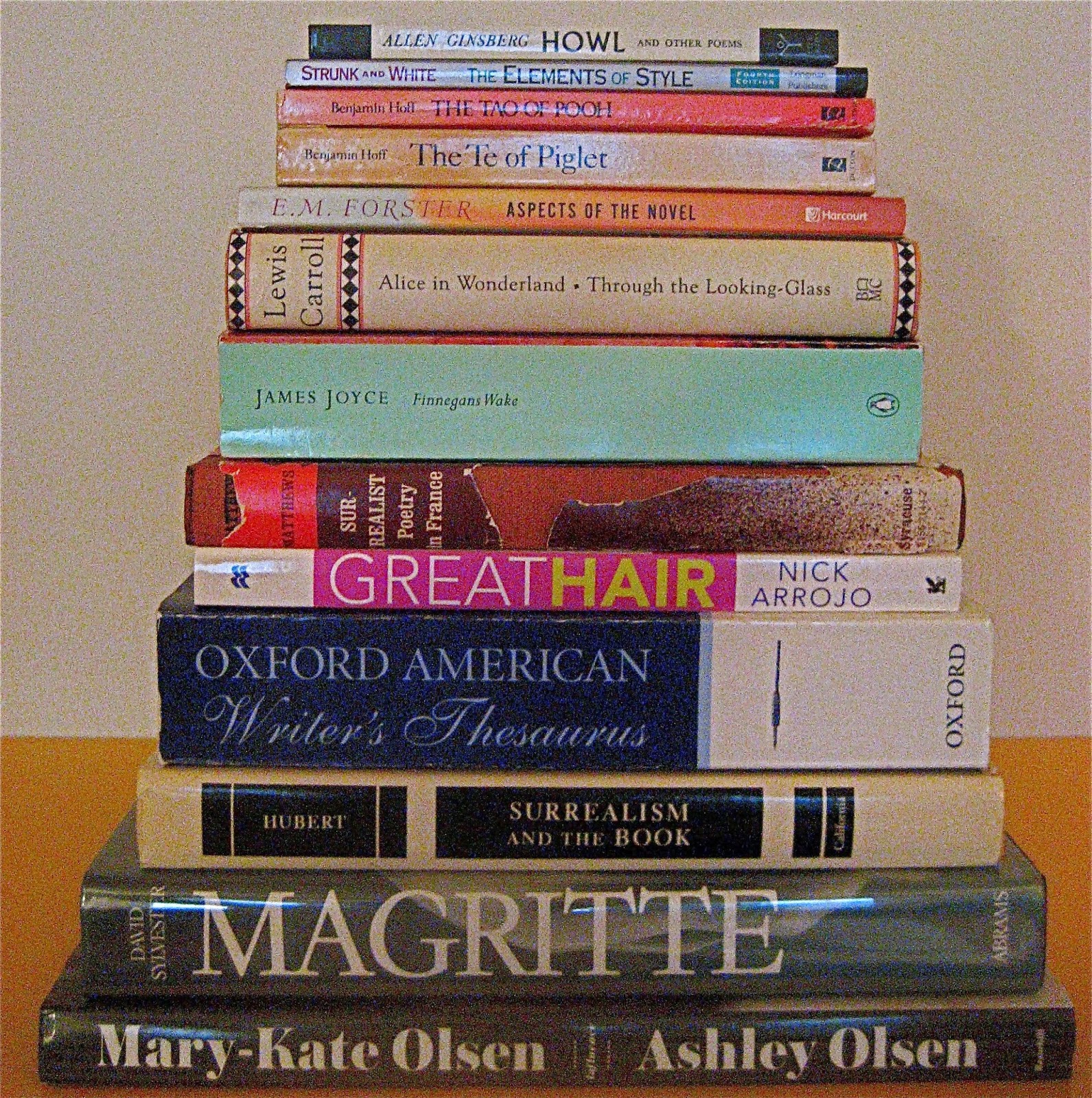
To conclude this gushy, unfocused, maybe slightly insane blog post, here are some of my favorite books. Not my favorite literary works, but the books that I count among my most treasured possessions.
Wednesday, September 9, 2009
Crazy shit.
In the past couple of months, nearly one hundred people have ended up at my blog after Googling some variation of the phrase "crazy shit." I find this kind of hilarious. What are these people expecting to find? Is my post about Salvia divinorum satisfying their yearning for some crazy shit? Apparently there is a CrazyShit.com, which hosts mostly pornographic video clips, as well as other video clips which, based on a glance at the thumbnail screenshots, seem gross and disturbing to me.
But if you are looking for some crazy shit that is neither pornographic nor gross and disturbing, I guess I can make a few suggestions.
Lately I have been reading The Portable Jung. I haven't been reading it very quickly, because every time I encounter a new concept, I get all excited and inspired and distracted and overwhelmed with ideas of my own, and I have to make a concerted effort to drag my attention back to the text. So far it seems like a pretty good introduction to Jungian psychology. I would say that it qualifies as crazy shit.
I would also recommend Daniel Pinchbeck's Breaking Open the Head: A Psychedelic Journey into the Heart of Contemporary Shamanism to any casual reader looking for some crazy shit. Of all the books that I have read recently about psychedelic shamanism, I would say that this one is the breeziest and most entertaining.
Last month, Ed and I went to the San Francisco launch of The Journeybook, which is an exploration of consciousness, spirituality, and psychedelic culture through essays, interviews, and artwork. So far I have only flipped through it briefly, but I am certain that it contains a plenitude of crazy shit.
The other unread book lingering on my bookshelf is The Phenomenon of Man. Pierre Teilhard de Chardin, a French philosopher and Jesuit priest, wrote it in the 1930s, but the Roman Catholic Church prohibited its publication until his death in 1955. Teilhard's ideas about the evolution of consciousness sound totally crazy and also very appealing and exciting.
If you don't want a whole book's worth of crazy shit, you might be interested in the essays at Reality Sandwich. Some of them are a little too crazy, even for me.
Or, if you want some cinematic crazy shit, Ed and I have been getting into Hayao Miyazaki lately. We actually haven't seen Ponyo yet. But Spirited Away, Princess Mononoke, Kiki's Delivery Service, Howl's Moving Castle, and Laputa: Castle in the Sky are all very crazy and trippy and wonderful.
I think that's pretty much all the crazy shit I have to offer at the moment. If that wasn't what you were looking for...too bad.
Wednesday, September 2, 2009
Why reading is like sex.
I tend not to read much contemporary fiction. I am the type of person who compulsively reads anything with text in my vicinity, so when contemporary fiction falls into my lap, I read it. But I never think to seek it out, so unless I'm looking for something to read at an airport or my parents' house, I usually gravitate toward the dead white guys.
This is partly because I majored in English at Middlebury, and while I don't want to generalize about the experience of everyone who ever majored in English at Middlebury, I personally found there to be a strong emphasis on the canon and very little emphasis on anything else. Of course, this had a lot to do with the classes that I chose. I did read Coetzee's Disgrace for the senior comprehensive exam, and I took Contemporary Ireland Through Fiction and Film for my freshman seminar so, obviously, I read some contemporary Irish fiction. But for the most part, we stuck to the classics. And as I read all these important and influential books I became increasingly aware of all the important and influential books that I had yet to read, and the list of books that I intended to read just kept growing exponentially, and of course it's impossible to ever catch up.
But there's another, weirder reason. As much as I'd like to be more familiar with what other people are writing and reading and discussing right now, there is a part of me that remains hesitant. Because books by living authors are a little bit scary. Dead authors are safer.
I have this extremely obnoxious habit of subconsciously measuring the text that I'm reading against some hypothetical projection of my own potential literary genius. So I'm reading from a critical, analytical distance, and in the back of my mind there's this nagging voice, just compulsively evaluating as I go along. Yes...hmm, that's interesting...ah, I see what you did there...oh, so this is going to be a theme...ooh, that's a nice turn of phrase... But if the book is really great, at some point that arrogant little voice will stop short. Oh, wow. I don't think I could have done that. This is good. Once that moment comes, I lose the self-conscious distance and I allow myself to get swept away in the text. My ego floats away and I give myself over the author. It's a blissful sensation. To me, it's the literary equivalent of an orgasm.
And it's so much easier for me to lose myself in a book if the author is dead and his or her genius is well established. Because with the author's reputation as a safety net, I don't have to trust my own instincts. I have the validation of countless literary scholars. And since a dead author only exists on the page and in my imagination, he or she can't intrude on my reading experience. So it's a bit like masturbating. I'm relaxed and alone and comfortable and the orgasm comes quickly and easily.
But when the author is alive and I don't have years of critical context to fall back on, the experience is more challenging. I'm forced to confront the author's continued existence. He or she is out there in the world, being a person, just like I am a person. The author is looking over my shoulder as I read, which makes me feel awkward and self-conscious and pulls me out of the book. I have to like and respect and trust the author before I can relax enough to let myself go. So it's more like sex. Not so safe, not always so comfortable, especially when the author is new and unfamiliar. Things are more likely to go awry. Of course, when the chemistry is right, the experience is vastly more rewarding. But you have to take a risk.
So basically, what I'm saying is that canonical fiction is to masturbating as contemporary fiction is to sex. (Incidentally, did you know that the new SAT doesn't include analogies? How tragic is that? Analogies were by far the most fun and challenging part of the SAT!) Also, I guess I should try to be more promiscuous, as far as reading is concerned.
Friday, May 15, 2009
Feminist psychonauts?
In my fantasy world, everyone would be a feminist psychonaut. But in reality, I think there are probably very few people who would describe themselves as such. So to discover a book about the uniquely feminine aspects of shamanism was an extremely pleasant surprise.
In The Woman in the Shaman's Body, Barbara Tedlock skillfully weaves extensive anthropological research together with stories about her own experiences studying shamanism around the world and becoming initiated by a traditional Guatemalan shaman. Tedlock is uniquely qualified to speak on this subject, and she does a phenomenal job of uncovering the role of women in traditional shamanism, as well as holding other scholars accountable for their failure to include women in their own shamanic research. This is an incredibly fascinating book. It's much better than I expected it to be, and I highly recommend it. It's far more accessible and entertaining than the cover might lead you to believe.
Friday, April 17, 2009
You should read Food of the Gods.
Food of the Gods is without a doubt one of the most fascinating and intriguing books I have ever read. (And I have read a lot of fascinating and intriguing books.) Anyone with any intellectual curiosity whatsoever should read this book. Even if you are completely resistant to Terence McKenna's ideas regarding psychedelics, you will still find plenty here to ponder and enjoy.
McKenna starts out by establishing his thesis: that psychedelic mushrooms are the original "tree of knowledge." The beginning is tough, because it's obviously difficult to make any kind of convincing, coherent argument about archaic cultures. McKenna makes a valiant attempt, though, and backs up his assertions with as much evidence as one could reasonably expect. I found this part of the book to be the most difficult to follow, and I imagine that many readers would find it equally difficult to swallow.
Once you've muddled through the first part, Food of the Gods becomes increasingly accessible. McKenna tracks the rise of various substances and their influence on the development of culture. "Drugs," in this book, are defined in such a way as to include alcohol, tobacco, tea, coffee, sugar, chocolate and television. As tempting as it may be to dismiss this interpretation out of hand, McKenna offers a wealth of thought-provoking historical knowledge that is worth considering.
Food of the Gods presents so many controversial, perplexing, and frequently compelling ideas. I don't believe that they are all meant to be taken literally, and even if they are, I wouldn't. But it is worthwhile and occasionally even inspiring to be exposed to such a radical perspective on humanity.
Thursday, March 26, 2009
Reading is fundamental.
So I've been revising and polishing my screenplay, and I think it's pretty close to being done, which means that it's about time to start working on the next one. I have a rough idea of what I want to do, but it's not enough to start outlining a story or create a logline just yet.
First, I need to do some research. I ordered a few books to get started, and I'm really looking forward to delving into them. They are:
Food of the Gods: The Search for the Original Tree of Knowledge, by Terence McKenna
Breaking Open the Head: A Psychedelic Journey into the Heart of Contemporary Shamanism, by Daniel Pinchbeck
Mushroom Wisdom: How Shamans Cultivate Spiritual Consciousness, by Martin W. Ball